Looking for Lilian: part 2

So, we take up the story of my great aunt Lilian (Bruce née Cockrill) in the mid-1930s (and a quick reminder that you can find her in the family tree here).

Life after Llewellyn

For whatever reason, Lilian’s marriage to Llewellyn Bruce did not last and she returned to her old life, lodging in large houses divided into flats and bedsits in Adelaide Road and then later in nearby Fellows Road, Swiss Cottage (London Borough of Camden).
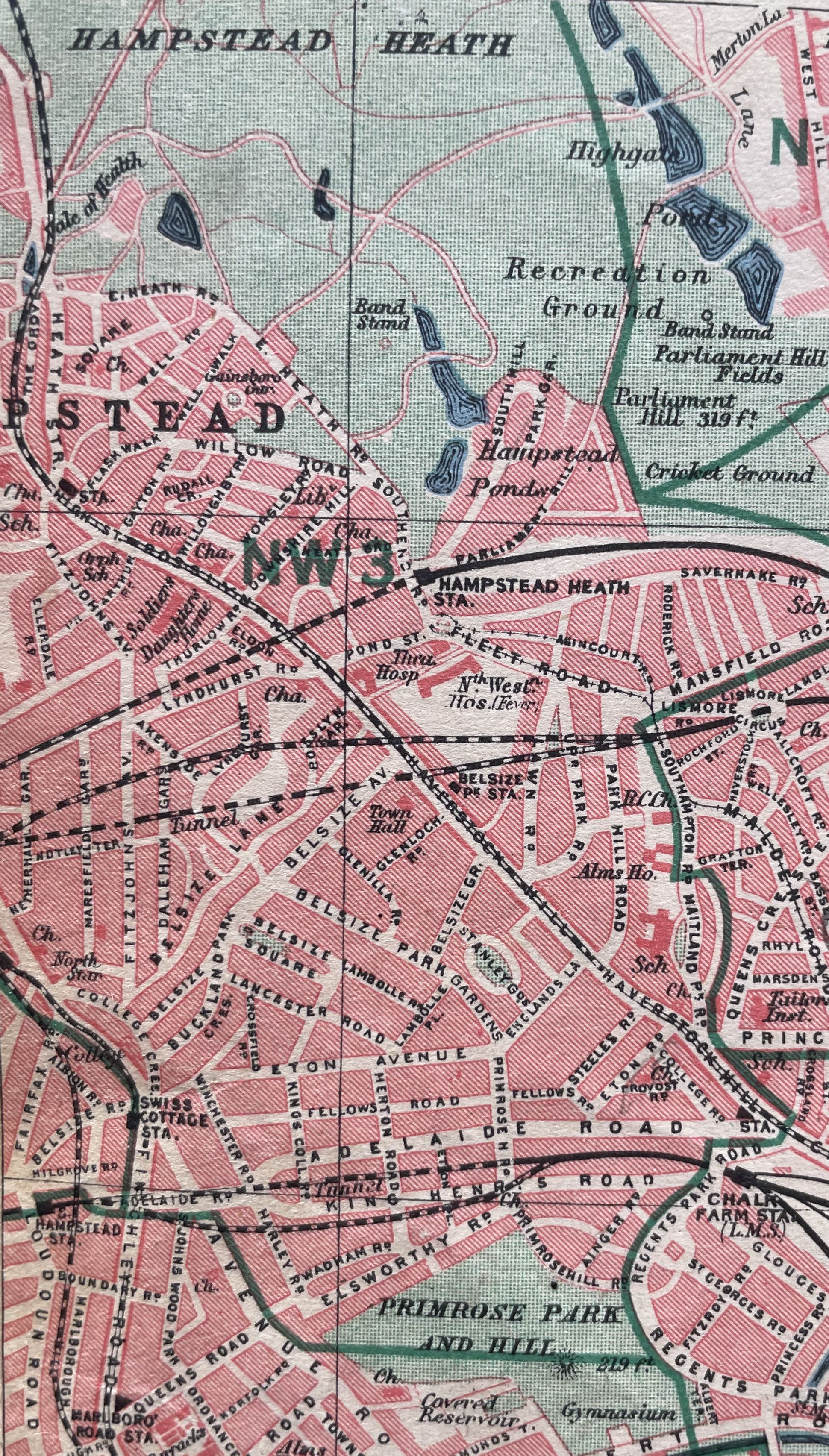
Page from the London Pocket Atlas and Guide (Bartholomew, 1939) showing location of Adelaide and Fellows Roads (between Swiss Cottage and Chalk Farm stations)

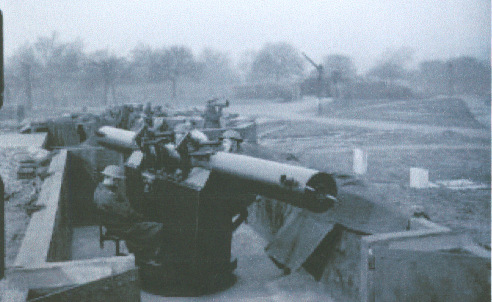
Prior to her marriage, Lilian lived at number 97 Adelaide Road. From around 1936, she moved a few doors down to number 115 where we know she was living at the start of the Second World War (WW2).  At the back of these houses, Lilian would have seen and heard the trains running north from Euston alongside Adelaide Road as they still do today. It was a dangerous place to be living during WW2 as the main railway line was a key target for the Luftwaffe (German air force).  She no doubt encountered huge silver barrage balloons (obstacles to enemy aircraft) floating in the vicinity as well as anti-aircraft guns on nearby Primrose Hill. The latter was just a short 5-minute walk downhill from her house where she could experience the iconic view of the London skyline set behind the green parkland.  She was also close running distance to Swiss Cottage and Chalk Farm tube stations, where many locals fled to the underground platforms during the London Blitz of 1940-41, when a German bombing campaign took place over Britain for just over 8 months resulting in two million houses being damaged or destroyed (60 percent of these in London).

Lilian was 38 at the start of the war according to the 1939 England and Wales Register, an invaluable resource for family, social and local historians. Taken on 29 September, the information was used to produce identity cards and, once rationing was introduced in January 1940, to issue ration books. For 115 Adelaide Road, Lilian is listed as a Secretary, Ladies Dept Clothing. One might assume this was in a department store in the West End. Others in the house share similar occupations, for example, Manageress Hosiery and Underwear, Shop keeper Dairy, HMOW (His Majesty’s Ordinance Works) Storekeeper. Lilian also states she is married but we know that she and Llewellyn never lived together again. Interestingly, Llewellyn declares he is single when he fills out the form for the same Register (see the previous blog for more details on Llewellyn’s ‘post Lilian’ story).  

Two naval anti-aircraft guns Primrose Hill, (War Office 2nd World War official collection)
Range finder and predictor Primrose Hill 1939 (War Office 2nd World War official collection)

By the end of the war, Lilian had moved to another house, one street back and parallel to Adelaide Road, at 97 Fellows Road.  Both Fellows and Adelaide Roads were built on land originally owned by Henry VI and later Eton College. Henry VI had founded this famous elite public school near Windsor in the 15th century. The names of the roads on the Eton College estate reflect their past, hence Fellows (referring to the College ‘Fellows’) and Adelaide, named after the reigning queen at the time that the road was significantly developed in about 1832.

Lilian was likely to have moved from Adelaide Road to Fellows Road due to much of the former street being heavily bombed out.  We know that within a week of the Blitz starting in London in September 1940, that during a relatively light night raid, a bomb hit Adelaide Road and killed 12 people.

Number 97 Fellows Road was the address from which she wrote to my father in 1945 (as mentioned in Part 1 of this blog post). She stayed here until about 1949 when she moved again, this time a few doors down to number 107 where she stayed for the next 15 years.

Just like her Adelaide Road homes, both houses had multiple occupants, singles in the main while their names sometimes give a hint to their heritage.  Further research has uncovered some fascinating details of their personal journeys. Lilian clearly lived in a cosmopolitan area, amongst artists, actors, shop assistants, waiters and waitresses, hoteliers and club owners, many of whom had a European background.  I know from my own work-related research around the Holocaust that this was an area where many Jewish refugees and others fleeing persecution in Europe found sanctuary.

Meet the Neighbours

One can only speculate how much Lilian interacted with her close neighbours. For example, how chummy was she with aging Film and Stage Actor, George Langley-Bill who lived alongside her at 115 Adelaide Road during the late 1930s? Did he entertain her with stories from his days at the Garrick or Lyceum Theatres before WW1 or the time he chased a pickpocket through the streets of the West End as reported in the Reynold’s Newspaper of 1913? Then there was her neighbour, dark haired, dark eyed Basilio Cranchi, variously confectioner, caterer, refreshment house keeper. Did he describe to her his childhood in the beautiful Italian village of Ballagio on Lake Como? Or his adventures as a hotel waiter in New York, crossing the Atlantic in 1916 on the very same ocean liner that had taken the US Olympic team to Stockholm four years previously?

Similarly, how engaged was Lilian in her neighbours’ lives when she was residing at 97 Fellows Road?  The year 1948 was a tumultuous time for some of them. It was the year William and Kate Itter’s daughter Irene, a teenage GI bride, returned from a failed marriage in America to live with them. Only two years previously, Irene had sailed with her baby daughter on the famous British ocean liner Queen Mary to re-join her husband in Missouri.  Was Lilian privy to all their family’s woes?

Meanwhile young married couple, Thomas and Kathleen Binovec were also experiencing difficulties. In January 1949, 32-year-old Thomas reportedly fell under a Bakerloo line train at Swiss Cottage station although the Daily Mirror gave a somewhat more detailed and sensational version when it not only reported the outcome of the inquest – ‘suicide while of unsound mind’ but also the railway foreman’s failed struggle to save him. Thomas was a hotel waiter whose Czech father, also Thomas, had arrived from Prague before the First World War (WW1) and had served in the British army. Thomas Senior was manager of the Czecho-Slovak Colony Club near Regent’s Park.  Later, his wife Blanche, the club’s bookkeeper, seems to have lived at 107 Fellows Road with Lilian while he was working as a hotel waiter in Canada. Remember Thomas senior as we’ll come back to him later.

Daily Mirror – Wednesday 02 February 1949
Image © Reach PLC. Image created courtesy of THE BRITISH LIBRARY BOARD.

Likewise, we ask how well did Lilian know her neighbours at this latter house where she was to live until the mid-sixties?  Some names stand out as being long term residents and with connected pasts.  Stuart Wynn Jones lived at this address for at least a decade from 1955. According to an article by multimedia artist Ian Helliwell in The Wire (November 2012 Issue 345 p32), Wynn Jones was an ‘advertising man by day, avant garde film maker by night’ and ‘this radical hobbyist was part of a UK post-war boom in amateur sound and vision experiments.’ He was a member of the British amateur animation collective, the Grasshopper Group who made hand-painted abstract films with musical soundtracks. He is particularly known for Short Spell (1963) which was a winner in the Annual Ten Best competition organised by Amateur Cine World, receiving numerous screenings and appeared on TV on the BBC Tonight program in January 1958. You can view it here

He features in an article in Amateur Tape Recording Vol 2 No 7 Feb 1961 here where he is pictured at work in ‘his small studio-cum-bachelor flat in Hampstead, London’. Did Lilian hear some of his experimental sound recordings involving taps running, pieces of paper being torn, sticky tape being pulled off the roll, or piano chords?
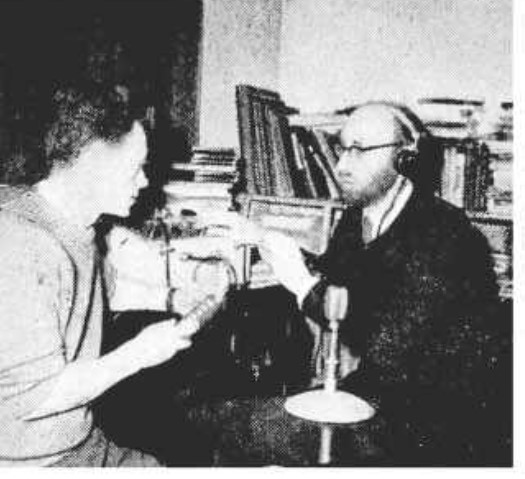
Richard Golding and Stuart Wynn Jones discussing capstans, in Stuart’s ‘small studio-cum bachelor flat in Hampstead, London’ which featured in Richard’s article ‘Sound and Vision Maker’ in the journal Amateur Tape Recording Col 2, No 7 Feb 1961

All Things Bohemian

The North London area where Lilian resided was an enclave of European refugees at the time, and apart from the Binovecs, there were other Czech neighbours in the houses in which Lilian lived. For example, there were the Hnideks from Bohemia consisting of Joseph, a fur worker with his wife Antonie and daughter Olga. Olga married another Czech, Ladislav Corny Češek, who was a member of the Czechoslovak-manned fighter squadron of the Royal Air Force in WW2.

But along with Lilian, one name stood out as a consistently long-term occupant of 107 Fellows Road. Karel Jirasek. In fact, on the Electoral Register of 1949 they were the only occupants (at least the only ones eligible to vote).  I began to dig deeper. Bear with me, as it will soon become clear where we are going with this!

When Lilian met Karel

According to the 1939 England and Wales Register, Karel aka Charles Jirasek was the Assistant Manager of a Travel Bureau at 37 Ainger Road in Hampstead (London NW3 3AT), not far from the Primrose Hill parkland.  He was born on 19 November 1891 and advertised his intended naturalisation in the News Chronicle on 30 March 1939. Remember fellow Czech, Thomas Binovec Senior?  He had also chosen to become a naturalised British citizen, advertising his intention on 21 October 1938. This no doubt was related to the then perilous state of their shared country of birth. A few weeks previously, the Munich agreement (the one where Prime Minister Neville Chamberlain brandished a piece of paper on arriving at Heston aerodrome proclaiming ironically ‘Peace for our Time’) had led to the Sudetenland (where ethnic Germans lived in Czech regions) being annexed to Germany. Soon Czechoslovakia ceased to exist, and by mid-March 1939, Nazi Germany had taken over all of Czechoslovakia, proclaiming both the Slovak state and the Protectorate of Bohemia and Moravia.  Karel, it seems, was intent on staying in Britain and to not return to his homeland.
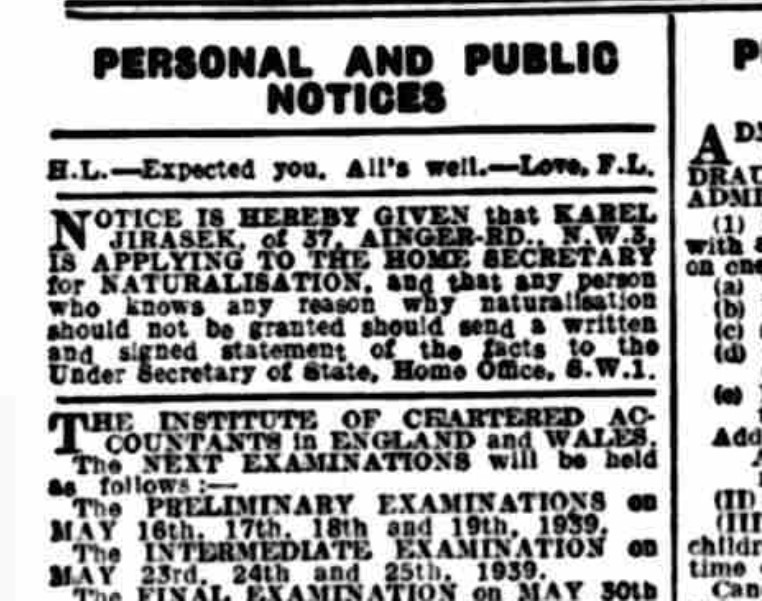
Karel Jirasek giving notice of his proposed naturalisation. Daily News (London) – Thursday 30 March 1939
Image © Successor rightsholder unknown. Image created courtesy of THE BRITISH LIBRARY BOARD.

Like many Czechs living in Britain at this time, Karel arrived at the time of WW1. There were around 1,000 Czechs and Slovaks living in London back then, the majority working as waiters just like Thomas Binovec who had arrived from Prague in around 1910. Like many others of their kinsmen, they wanted to show their allegiance to the allies by joining the British army, but as citizens of the Austro-Hungarian Empire they were considered ‘Aliens’ and prevented from doing so. However, rules were eventually slackened as the war necessitated increasingly more manpower. Both enlisted around the same age: Thomas was 24 and Karel 25.

This image shows new recruits at the Whitehall Recruiting Office, London where Karel Jirasek enlisted in June 1917. Britain’s declaration of war on Germany on 4 August 1914 was greeted for the most part with popular enthusiasm, and resulted in a rush of men to enlist. Copyright: © IWM. Q 42033, part of Daily Mirror Collection. Original Source: http://www.iwm.org.uk/collections/item/object/205021927

According to his military records, Karel was a 5’ 8” tall seaman, born in Nymburk, a town in the Central Bohemian Region of the Czech Republic, almost 60 km (just over 35 miles) northeast of Prague. He was assigned to the Royal East Kent Regiment or ‘the Buffs’ in June 1917 and was immediately sent to Canterbury for training. By March the following year, Karel was posted overseas where he suffered gunshot wounds to the neck, forearm and left knee and presumably sent back to ‘Blighty’.  In 1919, he was transferred to the 11th Hampshire Regiment and discharged from military service on 14 November 1920. According to his enlistment papers, he was living (assume lodging) at 48 Fitzroy Square (W1T 5BS), a beautiful Georgian square known as Fitzrovia near London’s Euston Road and Regent’s Park. Built in the late 18th century by noted architect Robert Adam and his two brothers, the square was originally designed to provide London residences for aristocratic families. These days it’s used for film locations (think ‘The Crown’, ‘Vanity Fair’ etc) and a prime location for offices and celebrity homes.  In fact, English film director, producer and screenwriter, Guy Ritchie, is based here, buying two adjoining mansions after his divorce settlement with ‘Queen of Pop’ Madonna.   However, on further investigation, Karel probably lodged at 48 Fitzroy Street, which carried on from Fitzroy Square, just around the corner. Occupants in the 1911 Census indicate that many European emigrants – French, German and Swiss – were living here. Today, it is listed as a Georgian grade II period townhouse built in 1790, and stepping outside you would see the BT Tower literally towering above you.

Still described as a seaman, Karel appears to have returned to London from Hamburg in 1923 on a German cargo steamer, the SS Elbe.

It is likely that Karel and fellow Czech expat, Thomas Binovec Senior knew each other.  By the start of WW2, Thomas was the manager of the Czech-Slovak Colony Club near Regent’s Park, where it is probable that Karel frequented.  At the time of Czechoslovakia being annexed by Nazi Germany, Binovec was reported in a newspaper article (Yorkshire Post, Thurs 16 March 1939, p8) as saying that ‘300 members of their club had served in the British army’. In the same article, an interesting aside is that the first President of the Czechoslovak Republic, Tomáš Masaryk had penned the constitution in the club’s writing room during his stay in London in the early years of WW1.

So, we can suppose that perhaps Karel met Lilian through the Binovecs: we know that she had lived in the same house in Fellows Road in 1948 as Thomas Binovec’s son and daughter in law, as well as later with his wife, Blanche in 1956 (along with Karel).

Looking at the Electoral registers we can see that Karel and Lilian were living at 107 Fellows Road, Hampstead (London, NW3 3JS) from 1949 to 1965.  Accommodation was difficult to come by in the years immediately after the war with so many homes destroyed and rebuilding taking place. It was around 1948/9 that number 107 became available. Since about 1900 it had been the family home, known as ‘Dalkeith’, of Edward Dalziel and his nine children.  From the mid-19th century, Edward ran a well-known wood engraving firm with his brother George. They worked on early numbers of Punch and Illustrated London News and collaborated with the Pre-Raphaelites on various illustrated publications. The last member of Edward’s family, his unmarried daughter Dora, died at number 107 in 1947 and later in the year all her valuable antique furniture and effects were sold at auction. It is then, one assumes that the house was renovated and turned into flats and available to rent, and when Lilian moved there from number 97, and Karel from Ainger Road.

Leaving London

In 1965, the bombed out parts of Adelaide Road began to be developed and replaced by the Chalcots Estate, a council housing estate.  For example, a 20-storey block of 72 flats called Blashford, (NW3 3RX), one of five tower blocks that made up Chalcots, was built on the site of Lilian’s former home at number 115.  The land where her home at number 97 stood became the Adelaide Nature Reserve and the site of corrugated iron sheds which today houses the vehicle repair shop, Modern Motor Ltd.

At this time, Lilian was in her early 60s and it seems that she decided to leave London and live out her final years, as was traditional for British retirees, out of the city and close to the sea.  Her new home was a semi-detached, two bedroomed house in Seabrook, a small village close to Hythe on the south coast of Kent. It backed onto woodlands, and it was a 20 minute or so walk down to the beach, where one had a choice of turning left to Sandgate or right to Hythe and the start of the 45 km (28 mile) long Royal Military Canal, originally constructed as a defence against the possible invasion of England during the Napoleonic Wars. It was also a 10-minute drive to Folkestone where, like today you can get trains to London or take a ferry across the channel ‘to the continent’.

We know this because her address – 19 Woodlands Drive, Seabrook, Hythe, Kent (CT21 5TG) was given on her probate records when she died there on 9 February 1972.  But what I next uncovered explains my previous preoccupation with all things Czech.

I decided to continue following the life of Karel aka Charles Jirasek and, bingo!  According to his probate records, Charles died at the same Hythe address on 20 March 1967.  Both he and Lilian had moved there in the mid-1960s and one can assume that they were living together as a couple for around 20 years, although there was no evidence of them ever being married. I also realised the possible motivation for moving to Kent. It might have been because Charles had been in ‘The Buffs’, the Royal East Kent Regiment during WW1 when he would have had memories of training around Canterbury, about 32 km (20 miles) away. 

Then, at last, I found the final piece to the jigsaw, Lilian’s last resting place which clarified her relationship with Charles.  At first, I couldn’t find her but through the BillionGraves website I found Charles, buried at the nearby Hawkinge Cemetery and Crematorium, (Aerodrome Road, Folkestone Kent CT18 7AG). The crematorium is built on the site of an old airfield used by Spitfire and Hurricane pilots during the Battle of Britain. Interestingly, the 1969 movie Battle of Britain was largely filmed at Hawkinge and the Jackdaw public house at Denton, about 8 km (5 miles) away.

Finding Lilian

And then when I found Charles, I found Lilian.  His gravestone has a simple epitaph ‘In Loving Memory Of Charles’. These must be Lilian’s words; and when she died five years later, she was buried with him. At the bottom of the gravestone it reads … ‘and of Lilian Dorothy Bruce’.  However, because of incorrect online information it was impossible to find her easily. BillionGraves gave her name as Lilian Dorothy Jirasek, and had also wrongly transcribed the headstone as Lilian Dorothy Price rather than Bruce.

Charles Jirasek and Lilian Dorothy Bruce’s shared grave at Hawkinge Cemetery, Folkestone and Hythe
England CT18 7QU. Courtesy of BillionGraves (SteveN photographer, ljayne123 transcriber, March 2018)

It was a somewhat breath-taking moment to find her. I felt I had got to know my great aunt Lilian during my online digging and had become quite fond of her. But the headstone is worn and looks uncared for. No-one has probably cared for over 50 years.  Hopefully, this will change. I have already amended the online details on BillionGraves and one day, I hope I can visit Hawkinge and stop to remember Charles and Lilian, and the life we never knew they had together.

And what of the ‘madame in Soho’ anecdote which was part of family folklore and mentioned in Part 1 of this blog post? We may never know the truth behind this throwaway line – was this accurate, was it slander, or was her lifestyle just misunderstood?  Her association with foreigners, sailors, artists, clubgoers may have raised eyebrows within some corners of her East End background while similarly her short lived marriage and living ‘in sin’ was perhaps frowned upon within the social mores of the time. One hopes that sharing this story online might one day bring forth some new information because although I have constructed something out of almost nothing, there are so many questions left unanswered!  Just a photo would be fantastic!
Looking for Lilian: Part I

When I was growing up, I had an Aunty Lily who featured greatly in my life – she was actually my great aunt, Lilian Gertrude Pursell, the elder sister of my paternal grandmother, Nanna Cockrill. But later, when I began delving into my family history, I discovered I had another great aunt Lilian, Lilian Dorothy Cockrill, the younger sister of my grandfather, Ernie, and therefore Nanna Cockrill’s sister-in-law.  It’s the latter, the elusive Lilian, I’d like to talk about here.

The Letter

(If you need to ‘follow along with the song sheet’, a quick reminder that the family tree is here).

On first learning about Lilian Cockrill around 40 years ago, she intrigued me.  What intrigued me most, and perhaps disappointed me as I grew older, is that I never met her. But could have. She died in 1972 when I was 12 years old.  Not having the opportunity to meet her had a lot to do with the Great Cockrill Family Rift which needs a blog post (or two) to explain in detail but I will give you an inkling as I begin to unravel Lilian’s story here.

The only two pieces of information I had about Lilian was a tantalizing scandalous family story (I’ll get to that later) while the other was more tangible: a letter she had written to my father in 1945, just after the end of World War Two.

I am not sure why this correspondence was kept but it has been invaluable. I’d love to share it with you here, but the letter is currently back in England. However, I do remember certain revelatory details within the contents. There were basic facts like Lilian’s address in Hampstead in north London, and her married name Bruce. Mrs L.D. Bruce was written on the back of the envelope and, thanks to my old-fashioned primary school that taught me traditional letter writing etiquette, I knew that the use of her own initials and not that of her husband’s indicated that she was either divorced or widowed. There were also more subtle nuances that gave an insight into her education and personality. It was a well-written letter, in format and style. It was also warm and chatty. She talked as if she knew her nephew (my dad) quite well and looked forward to catching up after the war. It was also a wonderful piece of social history as she admitted (if I remember rightly) to ‘getting squiffy’ on the day war ended – 8 May 1945 – VE (Victory in Europe) day.

Sadly, I don’t think my father and she ever did catch up after the war. It seems Lilian’s attempt at making peace with my father at a time of world peace never came to pass. Nanna Cockrill apparently purposely distanced herself from the majority of my grandfather’s family, caused by a series of situations which would fit admirably into a BBC East Enders storyline. This is how I understand it. Firstly, my grandfather Ernie left home as soon as he could because his mother (Sarah Ann Hollingbery) replaced his father (Albert Edward Cockrill) with someone else; secondly, later my grandfather fell out with his younger brother (Laurence William Cockrill) because Laurie took his ‘patch’ whilst they were in business together as coal merchants. And thirdly (drum roll) apparently Lilian was ‘a madame in Soho’. I longed to find out whether this was fact or just family hearsay based on disapproval and misunderstanding of her lifestyle.

Seemingly, the only time Lilian came into contact with our family again was in 1967.  This was on the death of her mother (Sarah Cockrill née Hollingbery). She called upon Nanna Cockrill in Hackney to inform her of the fact. Nanna Cockrill and her mother-in-law (my great grandmother) lived less than a mile away from each other but had remained estranged for over 30 years.

And so, over the years I have taken up the challenge of looking for Lilian. Or was she known as Lily or Lil? Who was she?  Perhaps we shall never really know but with the help of Ancestry, FindMyPast and British Newspapers Archive and many other online resources, I am beginning to build up an, albeit hazy, picture.

Growing up in Hackney

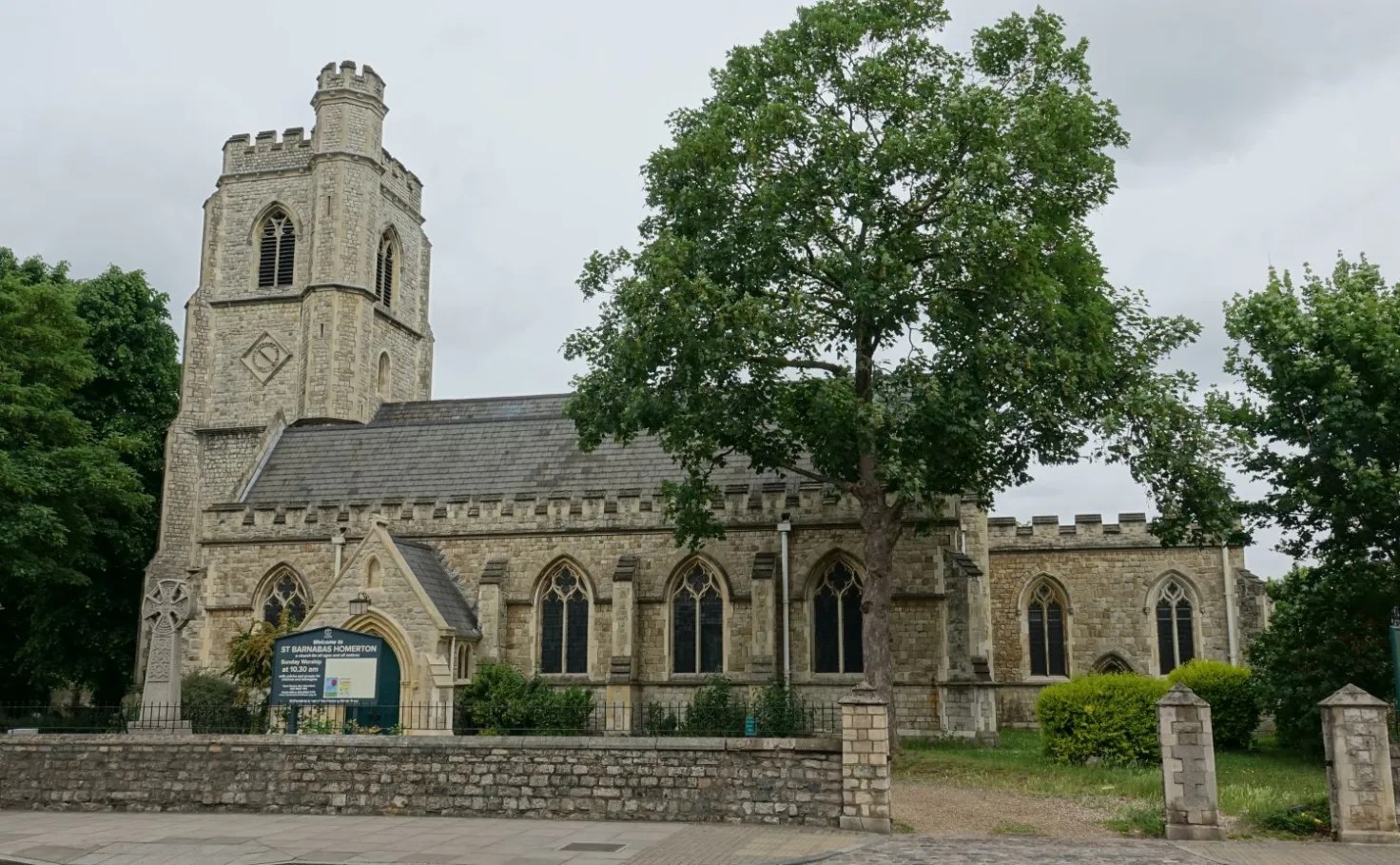
Lilian was born into a new Edwardian era on 14 July 1901 to my great grandparents, Sarah Ann née Hollingbery and Albert Edward Cockrill. Following the death of Queen Victoria six months previously after a 63-year reign, England and the Empire were becoming accustomed to her son assuming the role of King Edward VII. Lilian was born the first girl into a family of three boys all close in age. Their new sister was no doubt a novelty to six-year-old Albert, to Ernest (my grandfather) who had just turned five a week before she was born, and to Frederick, almost four. She was to be the only girl in the family for there were three more brothers to come.  At the time of her birth, the Cockrill family were living at 37 Swinnerton Road (London E9 5RG), a short walk away from Homerton High Street where Lilian was christened at the Parish Church of St Barnabas when she was four weeks old.

St Barnabas Church, Homerton High Street, where Lilian was christened (Image: https://londonchurchbuildings.com/2013/02/06/st-barnabas-homerton-high-street/)

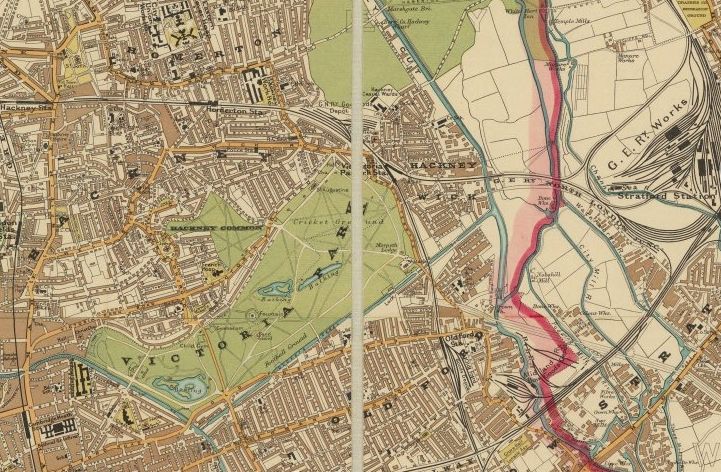
A 1905 map of the area shows us that Swinnerton Road lay between the grim Hackney Workhouse and Mabley Green, a piece of common land that is separated from the Hackney Marshes beyond by the River Lea, which wends its way from Bedfordshire, down to the Thames at Bow Creek. The Hackney Workhouse is no more but Mabley Green has been a recreational area since the 1920s, now with an Astroturf football pitch and more recently a famous giant boulder for rock-climbing. The old map also shows us that the Great Eastern Railway (GER) North London Line ran close by, with a station at Homerton and also at Victoria Park.  A stone’s throw from their house was the GER Hackney Wick goods yard. It was here one assumes where Lilian’s father, my great grandfather Albert worked, as in the 1901 census he is listed as a Railway goods porter, ie employed to load, unload and distribute goods on the railways. The GER had operated in this area from 1872, developing considerably around the 1890s to service the expanding suburbs of northeast London and to connect with the main line to Cambridge. It was absorbed into the London North Eastern Railway (LNER) when the country’s railways were grouped into four companies following the Railways Act of 1921.

Old Map of London Stanford’s Plaistow – Aldgate – Homerton – Millwall c1905 (detail showing Hackney Wick and Victoria Park)

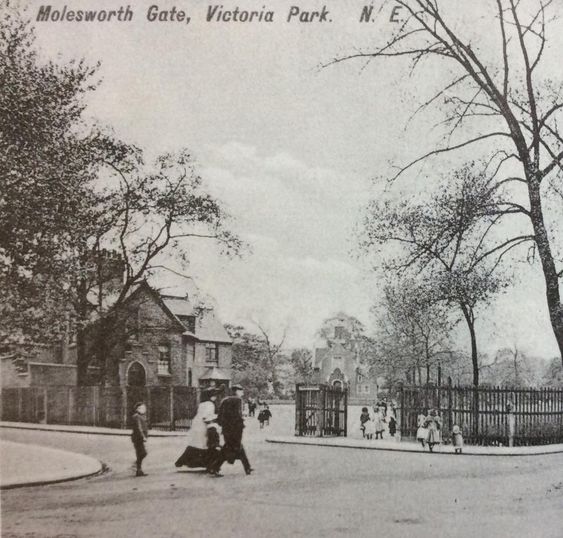
There were several other men in Swinnerton Road, who were also railway employees. The Cockrill family shared the house with the Parnells, similar in age. One assumes that each family had a floor of the house. John Parnell was a Railway Goods Checker – no doubt intrinsically linked with Albert’s job but did they also ‘hang out together’ at home? John’s eldest son George was the same age as little Frederick Cockrill, while his daughter Ada was around a year older than Lilian.  One can imagine that perhaps the families visited Victoria Park together on Sundays, for the Molesworth gate was just 10 minutes’ walk away. Since 1865 the park had been a welcome haven for East Enders with its 213-acre boot-shaped expanse of grass, containing both cricket and football grounds, and three small lakes for boating and bathing.

c1900 Postcard of Molesworth Gate, Victoria Park, Hackney

Both the world at large and Lilian’s world changed dramatically again by the 1911 census, held on the night of 2 April. King Edward VII had died the previous year and his son was shortly to be crowned King George V. By now, Lilian had lost her brother Frederick, who died aged only five in 1903. She had also lost her father who at some point left the family home (and so far, frustratingly without trace) in around 1905. The circumstances are mirky but what is clear, as attested by the census return, is that it was Albert’s older brother James Cockrill who took his place. Lilian now had three more brothers, Reginald, Percy and Lawrence, the last two being fathered by James, according to their baptismal records. One can only imagine the nature of the family dynamics at this point. However, within a few short years, the world and individual families were transformed again by the Great War, later known as the First World War (WW1). Lilian’s two older brothers Albert and Ernest (Ernie) both enlisted but only one returned. Albert Henry Cockrill was killed in action at the Battle of Loos in France on 13 October 1915.  Ernie served overseas in Egypt and Salonika but was discharged from duties through ill health in 1916. Returning to England he chose to live with his grandmother (my great great grandmother) Emily Hollingbery because of tensions at home due to his mother’s relationship with his uncle.  In 1920 Ernie married Florence Daisy May Pursell, our Nanna Cockrill.

But let’s head back to Lilian’s story. By 1921 she was 19, almost 20, living with her mother and stepfather/uncle, and three younger brothers, at 22 Berkshire Road, Hackney Wick which was the Cockrill family home from the WW1 period for many years to come. Lilian was a shorthand typist for Achille Serre Dryers Ltd which was based in a large factory on White Post Lane in Hackney Wick, just a 5-minute walk away. By the mid-1920s, the company employed 1500 people and serviced well over 100 shops in the southern half of Britain. It had been started by Parisian ribbon dyer, Achille Serre in the 1870s who first introduced ‘dry cleaning’ to Britain. The company lasted 100 years and was later bought by Sketchleys. The business’s success was due to having the latest machinery as well as high standards of service. Advertisements for the company in newspapers and journals such as the literary and society periodical, The Tatler indicate their clientele at this time: those that enjoyed the high life and needed their gowns, furs, feathers cleaned on a regular basis. Lilian was perhaps beginning to encounter a different world to her working-class East End past.

Advertisement for Achille Serre Ltd in The Tatler No.1021, Wed 19 Jan 1921. (Image © Illustrated London News Group. Image created courtesy of THE BRITISH LIBRARY BOARD)

New Life in North London

When Lilian was in her 20s, she moved out and headed for north London, where large 19th century houses were being divided into short and long term lets for those working in central London, easily accessible by public transport. Throughout the late 1920s and most of the 1930s she lived at two different houses in a long street called Adelaide Road (now the B509) in NW1, in walking distance to Primrose Hill and Regents Park. I love the connection with Adelaide in South Australia, my hometown for the last 20 years! In fact, both the road and the city were named after the same person, Queen Adelaide, formerly Princess Adelaide of Saxe-Meiningen, and later Queen Consort of United Kingdom and Hannover, as wife of King William IV from 1830-1837. Adelaide the city was founded in 1836, while the road on the other side of the world began to be actively developed at about the same time.

Llewellyn Stephen Bruce

However, there was a brief period that Lilian was married, (roughly four years) when she lived with her husband Llewellyn Stephen Bruce in the leafy, north London suburb of Haringey at 26 Langdon Park Road (N6 5QG). According to their marriage certificate, he was a 27-year-old ship’s officer, the son of a retired Metropolitan fire brigade officer. She was two years older and interestingly, no job was noted next to her name on the certificate. They married on 10 January 1932 at the Parish church of St Clement’s Barnsbury on Westbourne Road (Islington). This Early English style church of 1865 was the work of renowned architect Sir George Gilbert Scott who, incidentally, was designing the famed Albert Memorial in Kensington Gardens around the same time. Today, the church is a Grade II listed building which has been turned into very expensive flats known as St Clement’s Court (60 Arundel Square, London N7 8BT, accessible from Davey Close).

St Clements Church, Barnsbury Arundel Square, London, N7 8BT where Lilian was married in 1932, is now a Grade II listed building (Image: Knight Frank)

None of the Cockrill or Bruce families appear to be witnesses at their wedding.  At the time, Lilian gave 98 Bride Street as her address, a 2-minute walk to the church and the home of William Hosking, a retired policeman and his family, where one assumes she lodged. William’s son in law, Ernest William Rodley, was one of their marriage witnesses.

There’s something about a sailor

It was short-lived marriage, and more research has uncovered a colourful life that may have been the initial attraction but also perhaps the downfall of the relationship (although this is pure speculation).

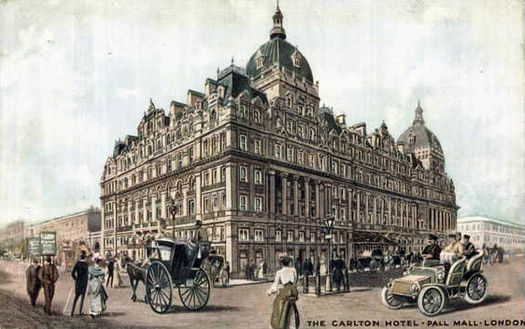
Llewellyn was born in Twickenham to Emily and James Carlton Walters Bruce.  His father James had been married twice before. Llewellyn had a half-brother James Walters Nicholson Bruce almost 10 years older, whose mother Louisa was his father’s second wife. James Bruce Senior was born in Swansea, Glamorganshire. His father, William (Llewellyn’s grandfather), hailed from Cornwall and was a mariner.  At some point James moved to London and joined the Metropolitan Fire Brigade. However, by the time he was 50 he had been pensioned off and during Llewellyn’s childhood, was employed as a fireman at the Carlton Hotel in Central London. In its early days, when run by the famous Swiss hotelier, César Ritz (‘King of Hoteliers, and Hotelier to Kings’ who gave us the term ‘ritzy’), the Carlton was one of London’s most fashionable hotels operating from 1899 for almost 40 years. It was situated on the corner of Haymarket and Pall Mall, adjacent to Her Majesty’s Theatre. Demolished during the 1950s, today the site is occupied by the 17-storey block of the New Zealand High Commission.

British postcard, c1905, showing the Carlton Hotel, London where Llewellyn’s father was a fireman in c1911

Llewellyn’s father James was proud of his Welsh origins. After all, he had given his son a patriotic first name: Llewellyn, Welsh for ‘like a lion’, or ‘leader’.  In the 1911 census return, James stated he is ‘Welsh’ in the Nationality box while in the 1921 return he is even more daring. In the Birthplace box, he wrote ‘Salubrious place’ underneath ‘Swansea’ indicating its health-giving properties!  The family at that time were now living in Wales, where they had shifted in around 1915, very likely indeed for James’ health. Working as a fireman in inner city London would have taken its toll. Home for Llewellyn was now at Llansteffan, a small village on the south coast of Carmarthenshire, on the estuary of the River Tywi. A Welsh-speaking part of Carmarthenshire, the Llansteffan peninsula was, and is, a beautiful stretch of coast, with sandy beaches, surrounded by farmland, an ancient castle on the hill while at the time, it was also possible to cross the estuary via ferry.  The area also has strong family links with Dylan Thomas. This famous Welsh poet spent his childhood summers during the 1920s holidaying in the area and we know he often stayed with his aunt at Rose Cottage on Old School Road. This was on the same street where Llewellyn’s parents lived (2, Bryn House, Llansteffan, Carmarthen SA33 5HA). Watch this short video of the Llansteffan long walk from Carmarthenshire County Council to get an idea of the beauty and history of this area. I certainly want to visit!

View from Llansteffan castle, showing estuary of the River Tywi with beach and edge of town below on left. (Image courtesy of Carmarthenshire County Council)

Both Llewellyn and his older brother James went to sea like their grandfather. James joined the Royal Navy when he was 16 years old. He married local Llansteffan girl Rosie John in 1916 when he was an Officer Steward, First Class serving on the HMS Hibernia, part of the Grand Fleet. During WW1, this ship frequently went to sea to search for German vessels and in 1915 the Hibernia played an important part in the Gallipoli Campaign. James and Rosie were to have three daughters who later helped their mother run a public house in Plymouth whilst their father was at sea.

Llewellyn also joined up at 16 but to the Merchant Navy. According to the 1921 census return, he was out of work at 17 although he had been employed by the Cardiff ship owners, D.R. Llewellyn Merrett & Price Ltd. In 1927 he appeared to be travelling regularly across the Atlantic from the Victoria Docks in the Port of London to New York on the RMS Carmania. According to crew lists, by the end of the year, he had been promoted from Able Seaman to Quartermaster and we learn that he was 5’ 7” tall. Carmania was a Cunard Line transatlantic steam turbine ocean liner and with her sister ship RMS Caronia, had once been the largest ships in the Cunard fleet. The prefix RMS meant she was a Royal Mail Ship, carrying mail under contract to the British Royal Mail. Launched in 1905, the following year the ship took famous science fiction writer, HG Wells on his first voyage to North America. Back then, the Carmania had been a luxurious ocean liner carrying over 2500 passengers in four classes. During WW1 she had been converted to an AMC (Armed Merchant Cruiser). However, by the time Llewellyn was a crew member, she had been refitted as a cabin class ship and kept busy until the shipping slump at the end of the decade due to the Great Depression and scrapped in 1932. One of her bells is on display aboard the permanently moored HQS Wellington at Temple Pier, Victoria Embankment, London, while another is at the Clydebank Museum in Glasgow. Check out this short presentation from Ballins Dampfer Welt which gives a great idea of life on board the RMS Carmania during the 1920s.

Postcard of the RMS Carmania, by the Art Publishing Company, Glasgow. Llewellyn was one of the crew who sailed to New York on several occasions in 1927

In 1929, Llewellyn spent six days in the Dreadnought Seaman’s Hospital at Greenwich having his T&As (tonsils and adenoids) removed. At that time, he was a Quartermaster on the P&O passenger ship SS Macedonia, which had been built by Harland & Wolff in Belfast in 1903, the same shipyard that had produced the infamous Titanic almost a decade later.

1927 postcard of Transportation and Woolworth Buildings, New York City (Image: Irving Underhill)

However, according to the hospital register Llewellyn’s home was cited as 31 Harewood Ave, W1 (London NW1 6LE) close to Marylebone station.  It is only supposition, but did he perhaps first meet Lilian whilst on shore leave at a London club, ‘up west’?  Did he regale her with his seafaring tales including his visits to New York? It would have been a fascinating time to have experienced the ‘Big Apple’, where the skyline was literally growing before one’s eyes and world changing events were taking place. We know he did at least four trips to New York in 1927 during the peak of the skyscraper building spree (1925-31). As he sailed into port, he would have spotted the then tallest building in the world, the Woolworth Building at 233 Broadway in Manhattan, which reached a height of 792 feet (241m). The Empire State Building on Fifth Avenue at 34th Street (1,250 feet or 381m with double the number of storeys) was yet to be built, being completed in 1931.

In addition, 1927 was the year pioneering American aviator Charles Lindbergh made the first transatlantic, solo, non-stop flight, successfully crossing the Atlantic Ocean and landing in Paris less than 34 hours later.  He took off from Roosevelt Field, an aerodrome on New York’s Long Island, in his Spirit of St Louis monoplane. 

And it was also the year that heralded The Jazz Singer, the world’s first ‘talkie’ – the first feature length motion picture with synchronised dialogue. Was Llewellyn in town on 6 October to experience the opening night crowds spilling out on to the sidewalk at New York’s Warner’s Theatre?

Lilian and Llewellyn went their separate ways in around 1936, Lilian back to her old life in north London while as far as we know, Llewellyn continued his seafaring ways.  Maybe that was the problem.

In 1939 Llewellyn was sharing accommodation at 55 Eastlake House, a block of flats in St Marylebone and was a Ships Quartermaster on the SS Rajputana, a P&O British passenger and cargo carrying ocean liner. In the past, her passengers had included Lawrence of Arabia travelling from Karachi to Plymouth in 1929 and Mahatma Gandhi from Bombay to London in 1931. Llewellyn was probably on one of the ship’s last voyages before she was requisitioned by the Admiralty to be used as an armed merchant cruiser for the coming war.  Fortunately, Llewellyn was not on board when the Rajputana was torpedoed and sunk off Iceland by a German U boat in 1941. 

Merchant seamen crewed the ships of the British Merchant Navy which kept the UK supplied with raw materials, arms, ammunition, fuel, food, and all of the necessities required by a nation at war throughout WW2. As a result, they sustained a considerably greater casualty rate than almost every other branch of the armed services and suffered great hardship. Research has shown that Llewellyn had two lucky escapes. He was one of six quartermasters on board the SS Malda which left the port of Newcastle at North Shields on 21 May arriving in New York via Halifax, Nova Scotia on 4 July (American Independence Day!) in 1941. However, less than a year later, on 6 April 1942, she was attacked by Japanese aircraft and then sunk by naval gunfire from IJN (Imperial Japanese Navy) heavy cruisers.  At the end of 1941, Llewellyn arrived in Glasgow on the P&O Viceroy of India. It was Britain’s first large turbo-electric passenger ship, and a British Royal Mail ship on the Tilbury Bombay route but the previous year had been requisitioned as a troop ship. In November 1942, she was sunk by a German U-boat in the Mediterranean.

But Llewellyn survived the war. He remarried Beatrice Lowe and had two children in the 1940s and they were living in Romford in the 1960s.  Llewellyn lived out his final years in the small seaside town of Holland-on-Sea, between Clacton and Frinton-on-Sea in Essex.  He died aged 79 in 1983.

Watch out for Part 2, when I continue my search for my great aunt Lilian.

Getting Started

Helping my (second) cousin Andrew Hallam to sort his family photos and memorabilia whilst I was in the UK this year, was what encouraged me to tidy up the family tree and initiate this blog. But it is also thanks to his dear late mother May that I was able to start unravelling many family mysteries with additional help from her cousin Arthur Hollingbery back in the 1980s and early 90s. At the same time, I’m indebted to all the previous research done by another cousin Andrew, Andy Hollingbery which can be found hereThe online family tree I’ve put together via Ancestry, now contains over 3000 names, although it is still very much a work in progress.  It has many branches, not just Cockrills but also principally Hollingberys, Pursells and Wests on my father’s side and Bettses, Brunnings and Kimmises on my mother’s side, as well as many more offshoots!
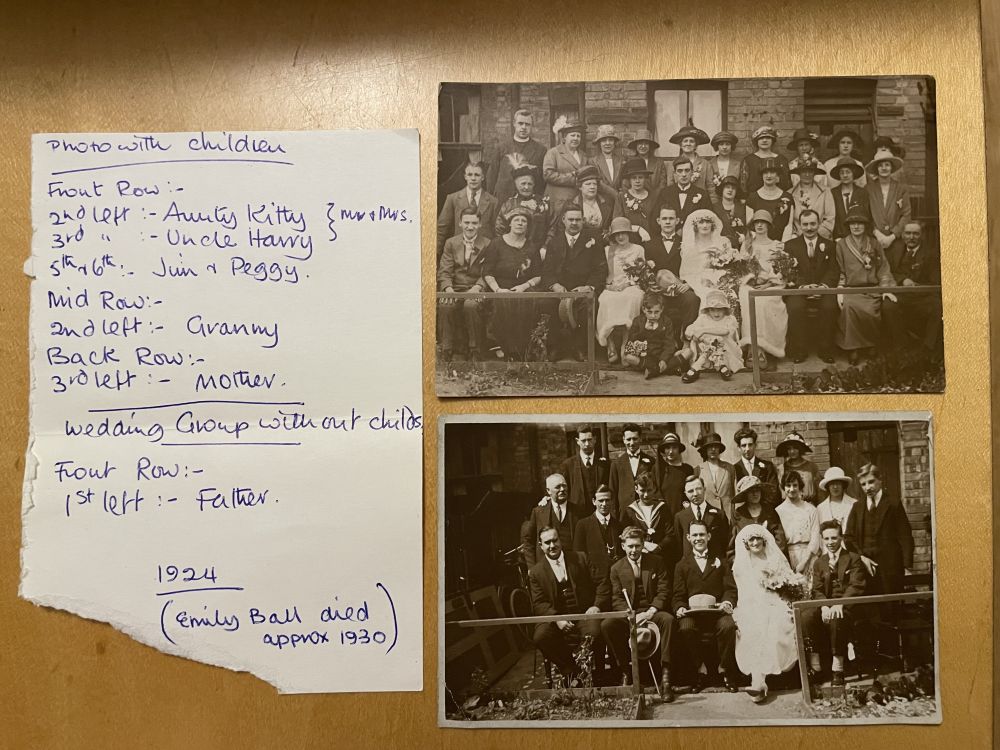
So I hope to uncover for you our Cockrill roots in Lincolnshire and how we ended up in the East End of London, and the complex connection with the Pursells and Hollingberys. I’ll show you how we made our money: you’ll find butchers, bakers and bootmakers but beer also plays a major part!  And I’d love to take you on a virtual pub crawl of the public houses managed by Hollingberys in London and home counties.Like all family histories, there’s tragic but also inspirational stories to tell. Which Cockrill was a London bobby in the very early days of the police force and had all his teeth knocked out in the line of duty? Which Pursell was among the over 400 men and boys on the HMS Captain who drowned when the ship capsized during a storm in the Bay of Biscay on 7 September 1870? And which direct member of our family ended her days in the Banstead Asylum in the late 19th century? 

I was particularly excited to learn of the number of family members on both sides who started new lives in far flung places in the late 19th and early 20th centuries – in Canada, the USA, Australia and Africa.

And what’s our connection with Maria Dickin, the animal welfare pioneer who founded the PDSA in 1917 and who lent her name to the Dickin Medal, the highest British honour awarded for animal displays of bravery in battle.

This blog also gives me an opportunity to share some of our great family photos from the past, and try to explain relationships and stories. I’m looking forward to this blog perhaps helping to identify some of the mystery faces and make new family online connections.